By Manuel Lazo
MAY 8
Like millions of other Americans, I grew up in a suburban community—Katy, Texas, to be exact. Situated at the crossroads of the bustling city of Houston and the sparsely populated rural communities of Southeast Texas, the city’s as suburban as HOAs and strip malls. Beneath the quaintness of downtown Katy and endless sprawl, however, is a town with an interesting political dynamic.
Whenever election season rolled around, I – as a politically inclined kid – remember being interested in deciphering which candidate Katy would vote for. From the obvious clues, such as yard signs or flags, to the trivial, such as apolitical bumper stickers, I took everything into account when ‘declaring’ a winner in Katy (for those interested, I had Trump winning the city in 2016, Biden in 2020, and Trump again in 2024).
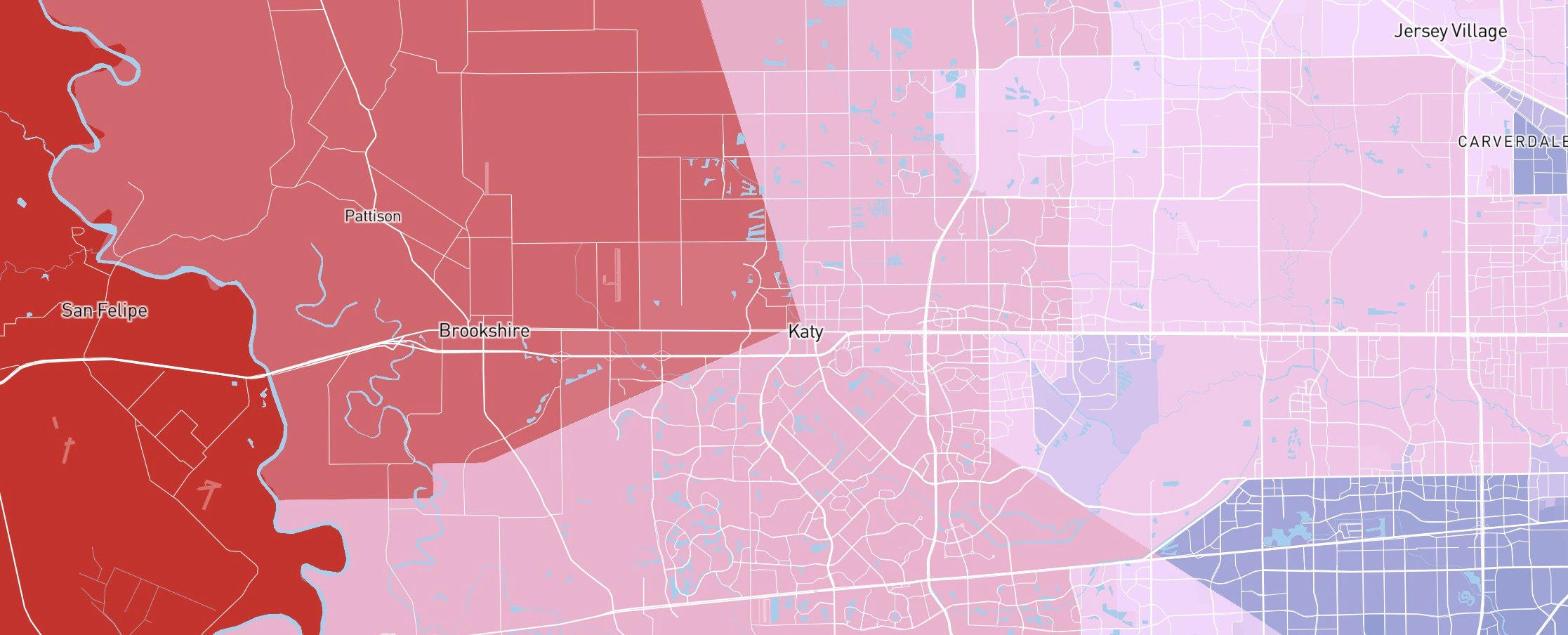
Katy, like a lot of suburbs, is politically diverse, and in conducting my little political experiments I made several observations. Namely, communities closer to Houston – and the city of Houston itself – leaned Democratic, while those farther from Houston leaned more Republican. I would later learn that this phenomenon is called the ‘urban-rural divide’.
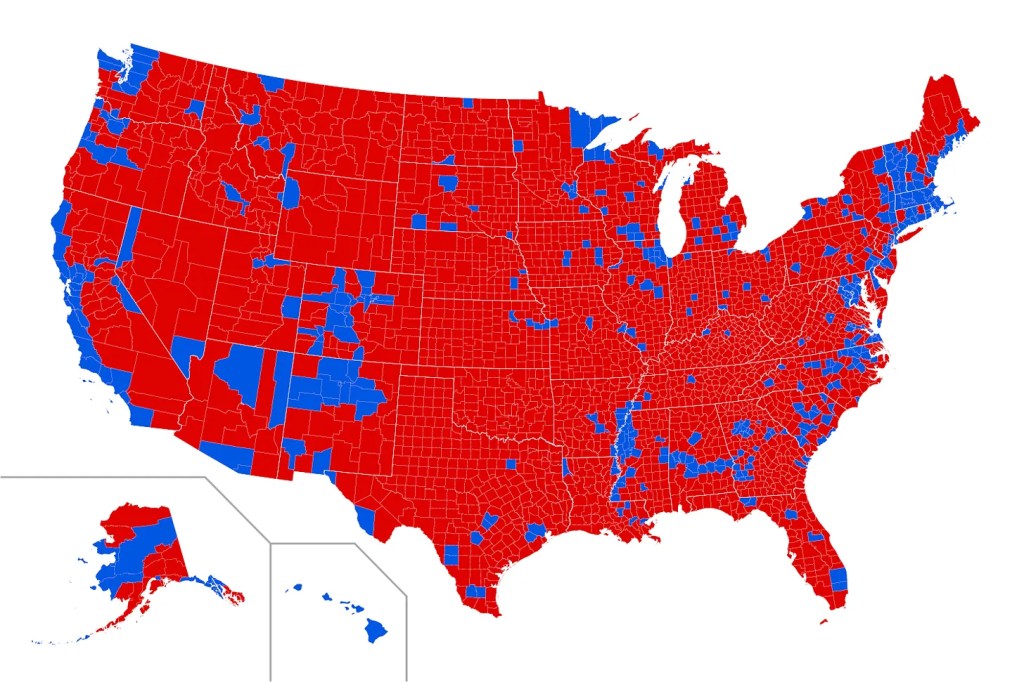
This divide is more than just an observation, it’s a political reality. In the 2024 presidential election, rural voters backed Donald Trump by a margin of 64% to 34% while urban voters split for Kamala Harris 60% to 38%. Out of the 10 most rural states in the country by percentage of their population classified as rural, seven of them voted for Trump in 2024—all of them by double digit margins. By comparison, only 4 of the 10 least rural states voted for Trump, two of which (Arizona and Nevada) are swing states.
But why is this the case?
Rural and urban voters have always had different priorities and interests, but never in our country’s modern electoral history has the discrepancy between the two voting blocs been this pronounced. As recently as 1996, Democrats weren’t just competitive in rural areas, they won the rural vote and carried states like Arkansas, Kentucky, and West Virginia.
The reason why rural areas lean so strongly towards the Republican Party is simple, Democratic messaging has been poor. Democrats have repeatedly promulgated ideas that don’t appeal to the common rural voter while failing to emphasize and fully embrace those that do. The fact of the matter is the current Republican Party platform resonates with rural voters, irrespective of whether or not it actually fulfills its promises to rural America.
The State of American Rural Areas
From the cottagecore online aesthetic to country songs glamorizing the ‘country lifestyle’, rural life is often romanticized in contemporary pop culture as tranquil, picturesque, and idyllic.
For most communities, however, the reality is very different.
The largest sectors in rural America by employment are healthcare and education services (22.3%), manufacturing (12.4%), retail trade (11.3%), and agriculture (~10%). All of these sectors have endured their own respective problems. Take agriculture for example, what was once the backbone of the American rural economy is now in a state of disarray fueled by rising farm debt, stagnant farm subsidy levels, and the largest decline in farm income in our nation’s modern history.
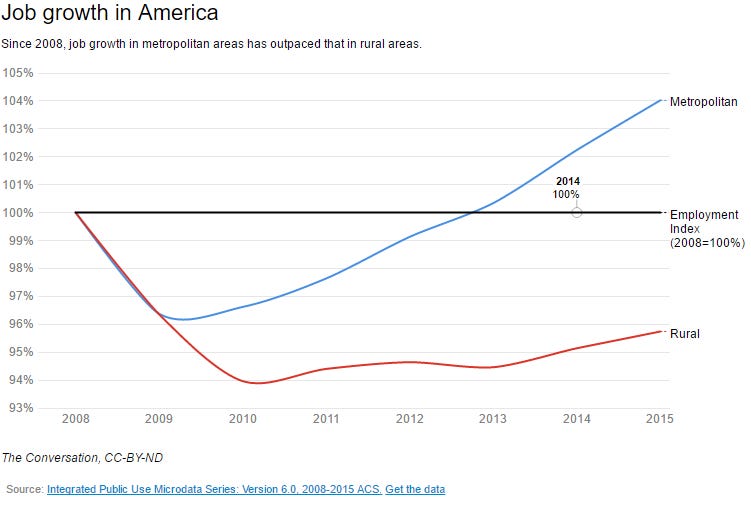
As the U.S. economy has transitioned to a knowledge, technology, and services-driven growth model, rural communities have been forced to play catch-up and continue to rely on blue-collar jobs that are uncompetitive domestically and internationally. Rural counties make up 80% of counties in the United States with long-term, persistent poverty, and 63% of rural counties had fewer jobs than before the Great Recession as of 2022.
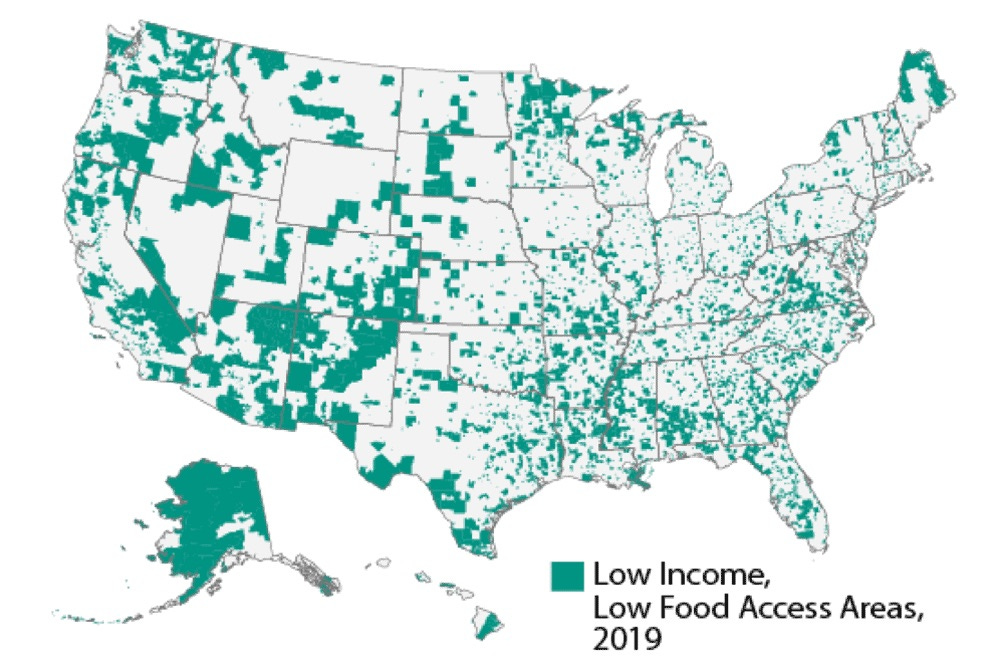
Additionally, rural areas in recent years have been characterized by the emergence of food and medical deserts – regions with limited access to adequate food or medical services. According to the USDA, 15.4% of rural households were food insecure in 2023, an increase from 14.7% the year before, and 84% of counties with the highest rates of food insecurity in children are rural.
Not only is food hard to come by in many rural areas, it’s also often very unhealthy. The scarcity of supermarkets and inadequate food distribution services has meant that many rural Americans depend on fast food restaurants and dollar stores for nutrition, resulting in higher obesity rates compared to urban Americans.
Meanwhile, rural healthcare is facing its own set of challenges. 44% of rural hospitals have negative operating margins, and 62 rural hospitals have closed since 2017 compared to only 10 that have opened. A lack of incentives coupled with ineffective medical policies has reduced medical access for millions of rural Americans. Specialties such as obstetrics and gynecology, trauma care, and mental health have been hit particularly hard.
The Democratic Rural Strategy
60 million Americans live in rural areas as designated by the US Census Bureau and rural voters made up 19% of the total vote in the 2024 election. It’s clear that rural Americans remain a critical voting bloc. So what strategies did the two parties use to win over voters in these areas?
The Democrats advanced a platform centered on expanding farmers’ social safety nets and supporting workers’ rights. On paper, these sound like prudent solutions that tackle real issues in rural areas. Take for example the following policy proposal in the Democratic Party Platform:
Democrats will keep working to grow the health care workforce, so workplace and other provider shortages no longer create barriers to quality care and inflate health care costs. We are investing in programs that train primary care practitioners, registered nurses, mental health specialists, and others to work across our health care system, including in rural and low-income areas.
Yes, it’s a set of vague political promises coated in buzzwords and jargon, but it also addresses the persistent healthcare issues that rural voters endure on a regular basis. The platform also endorsed measures to expand mental health access and increase USDA crop insurance coverage to improve rural food supply. These are far from perfect solutions, but there is substance and resonance in these proposals.
There are also, to put it bluntly, ineffective and faulty provisions in the Democrats’ rural policy plan.
The party platform makes extensive reference to unethical practices by Big Agriculture (Big Agra), writing:
American farmers are the backbone of our country. They feed America, and help feed the world. But over the years, trickle-down economics has hit rural America hard. Farming costs have gone up and incomes have gone down. Big Agriculture moved in, telling too many small farms that the surest path to success was to get big or get out.
While there are legitimate criticisms that may be levied on wealthy farms and agricultural corporations, this brand of political grievance aimed at corporations has failed to strike a chord with rural voters. In addition to evidence suggesting that ‘Big Agra’ has actually benefitted most agricultural communities, most rural voters’ frustrations in 2024 weren’t directed towards businesses, but rather towards the government. It’s a similar gambit to Kamala Harris blaming inflation on, of all things, corporate greed and proposing a federal ban on ‘price gouging’.
It’s easy to hate corporations, but it’s even easier to hate the government. Case in point: the Republican rural platform. It’s short on substantive rural policies, or even rural policies to begin with. But the few appeals to rural voters it does contain are very effective.
The Republican Rural Strategy
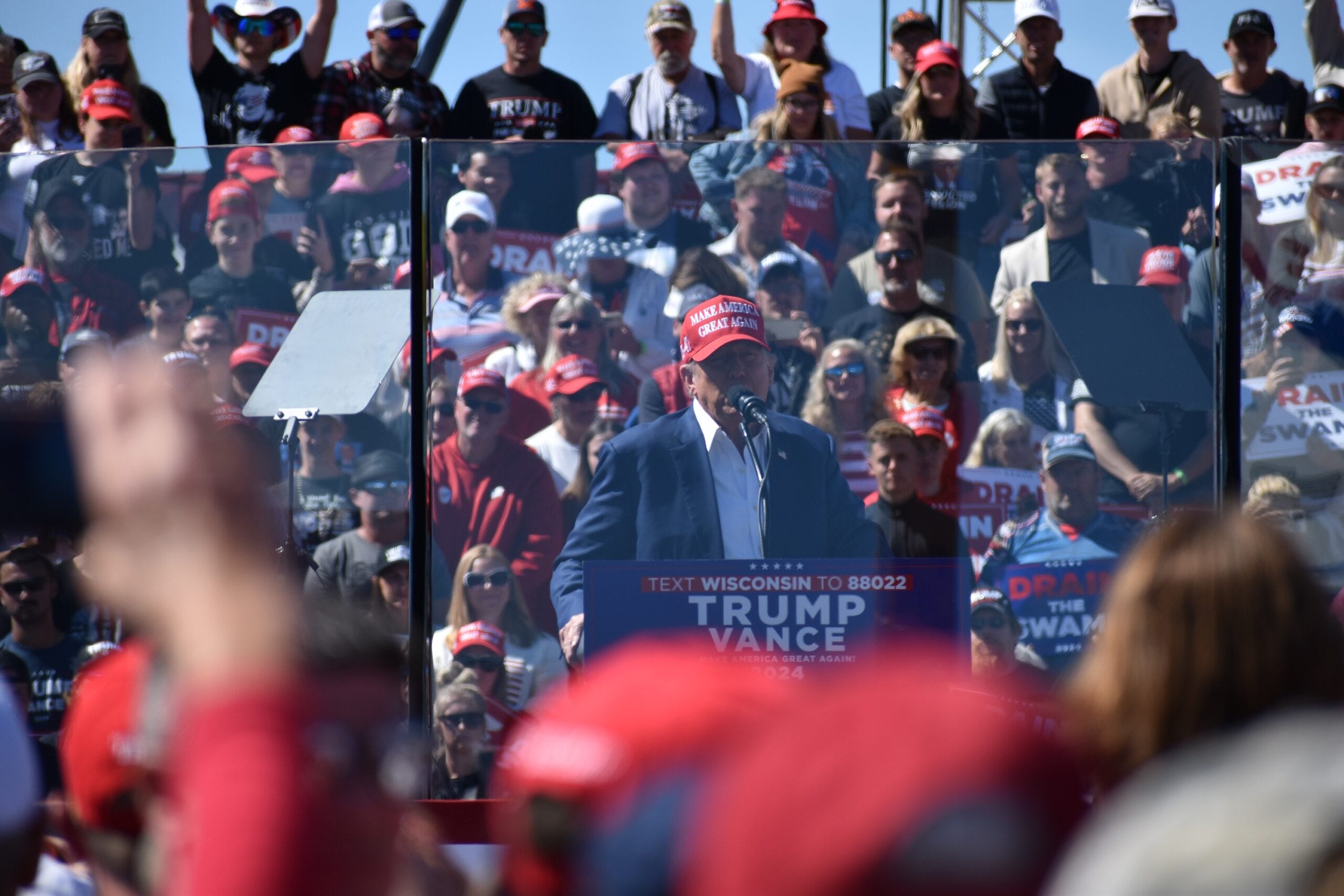
In the document, Republicans promised to ‘protect American workers and farmers from unfair trade’ by issuing tariffs on foreign countries, reversing Biden-era regulations, and restoring American manufacturing (without specifying how). Other indirect appeals to rural voters include proposals to combat inflation, support the American energy industry, and reduce illegal immigration. And who is responsible for the problems facing rural communities? The Biden administration, of course.
Republican rural policies aren’t the most sophisticated, groundbreaking, or detailed policies ever devised, and they’re not trying to be. Their effectiveness is instead reliant on emotions and impulses. Joe Biden, China, and immigrants might not be completely responsible for the social and economic crises of rural America, but they’re useful and convenient scapegoats that offer simple explanations to these issues.
By creating an ‘us vs. them’ dynamic with a clear antagonist, Republicans take advantage of the psychologically-proven political phenomenon of voters backing candidates that play the blame game and rally support against a ‘common enemy’. Add to this Christian sentiment, patriotic imagery, and nostalgic slogans such as ‘Make America Great Again’ and you’ve got a political brand that appeals to rural Americans’ feelings, values, and grievances. Compare this to the Democrats’ strategy of blaming issues on systemic injustices, political mechanisms, and complex economic dynamics and it becomes apparent that the GOP’s product is much easier to market to those that aren’t well-versed in political lingo (which are most rural voters).
Another critical difference between the two parties’ rural approach is their take on authenticity. People wonder how Trump – a multibillionaire from Manhattan – won the rural vote so convincingly in 2016, 2020, and 2024? The truth is that Trump never pretended to be ‘authentically rural’. Trump’s unique selling point was never his geographic, ethnic, or racial background. Instead, it was his status as a political outsider. By contrast, Joe Biden made his birth city of Scranton a major talking point during his electoral campaigns to appeal to working class rural voters despite being an establishment politician. The last thing rural voters want is an establishment politician in the mold of those who oversaw the decline of rural America in the late 2000s and early 2010s.
A Blue Rural America?
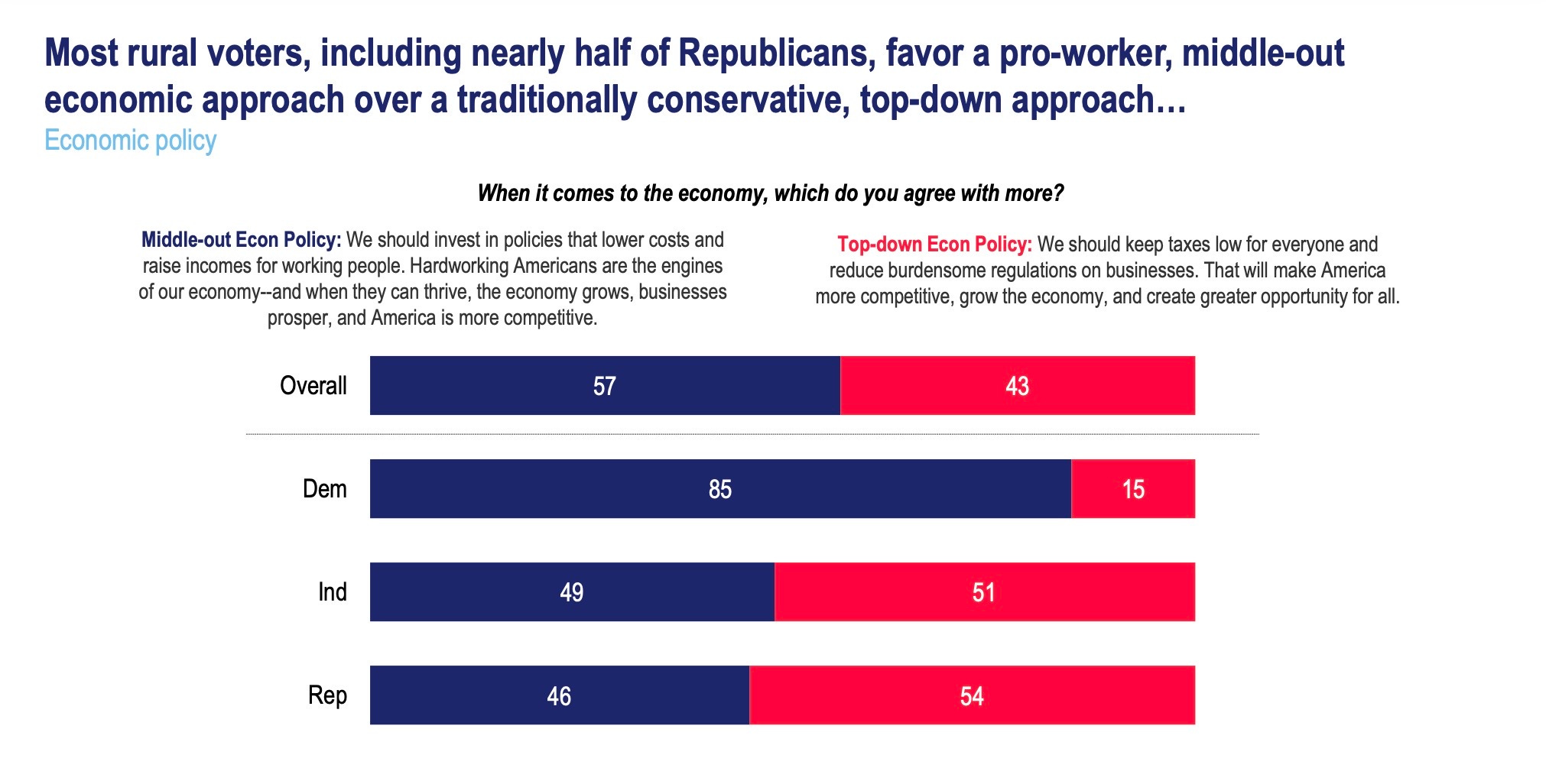
Like many American political trends, the current rural-urban divide isn’t irreversible and Democrats may have a realistic chance of winning back the rural vote in the near future…if things go their way. The good news is that certain Democratic policies are broadly popular with many rural voters. From Social Security expansion to infrastructure funding to a public health insurance option, several Republican voters – including rural ones – support these signature Democratic legislative priorities.
To develop a winning rural strategy, Democrats have to begin by improving their messaging and party organization. In 2023, Congress passed the landmark Inflation Reduction Act. The act authorized $20 billion in rural funding, capped prescription drug costs, and created the New Empowering Rural America (New ERA) program to build energy infrastructure and generate job growth. It was supposed to be a political victory for Democrats but instead it generally flew under the radar. A poll by the University of Maryland conducted shortly after the passage of the law showed that 71% of Americans had heard ‘little’ or ‘nothing at all’ about it.
Rural Democratic messaging has to be reevaluated to focus less on Trump and more on Democrats, less on policy details and more on the tangible everyday benefits of said policies, less on lethargic drawn-out speeches and more on animated community-oriented events. AOC and Bernie Sanders’ ‘Fight Oligarchy Tour’ is a good example of the type of messaging Democrats need to win over rural voters.
Additionally, Democrats must refine their policies to address real rural problems that are often overlooked by mainstream Republican politicians. The food and medical desert issues mentioned previously are prime examples, but Democrats can seize on Republicans’ inaction in several other areas.
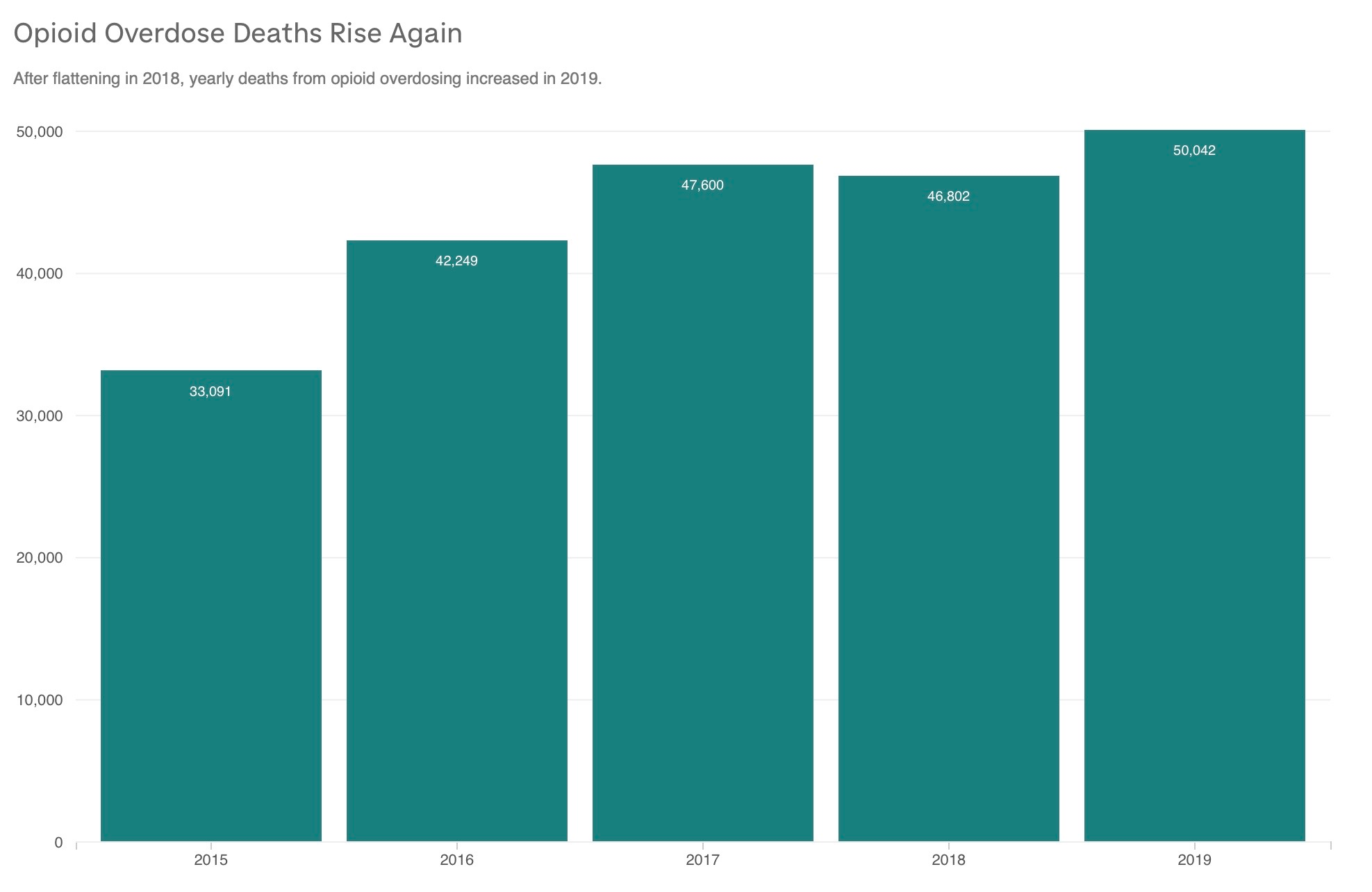
Take the opioid epidemic, for example. Trump ran in 2016 on a platform of reducing opioid-related overdoses in a year that saw opioids take the lives of 42,249 Americans, many of which were rural. That number escalated to 50,042 three years into his presidency, and he was criticized for defunding the Office of National Drug Control Policy (ONDCP). Now in his second administration, Trump officials are threatening to cut funding for naloxone, a life saving medication that treats overdoses. Have you heard of the Democratic outrage over this? Neither have I.
Democrats should also include a new farm bill as one of their main policy objectives. The last farm bill was passed in 2018, and farmers have been advocating for a new bill ever since. A comprehensive Democrat-sponsored bill covering conservation, farm subsidies, nutrition programs and more could greatly improve the livelihoods of farmers and draw rural voters to the left-wing column in local, state, and federal elections.
The Democratic Party’s image and some of its ideological stances must also be overhauled to cater to rural voters. As mentioned earlier, the Democratic Party platform is reliant on identity politics, too reliant in some instances, as seen in their support for DEI initiatives, racial equity, and transgender rights. Let me be clear, there’s nothing wrong with supporting these causes and they have their political merits when appealing to certain voting blocs. But this type of messaging won’t cut it in largely homogenous rural American communities. Instead, Democrats should infuse their messaging with imagery relevant to rural culture and lifestyles. Whether it’s religiosity, family values, or references to rural activities such as hunting or fishing, the Democratic Party has to devise a strategy to counter the cultural influence and resonance of MAGA within rural America.
This also means the Democratic Party must embrace populism, specifically agrarian populism in the vein of Robert La Follette or James Weaver. If Democrats want to have a realistic chance of retaking rural America, they must take a page out of the GOP. Trump’s brand of anti-elitism and perception of politics as a battle between ‘good and evil’ has turned the Republican Party into a rural political juggernaut. Democrats don’t have to go to his extremes or use the incendiary language associated with him, but embracing rhetoric centered around ‘the people’ and playing into grievances against elites will go a long way in regaining lost rural voters.
Last but not least, Democrats must nominate candidates that differ from the status quo and understand rural political demands. A great example is Marie Gluesenkamp-Perez, a Democratic congresswoman from Washington who won election to the House of Representatives in 2022 despite running from a Republican-leaning rural congressional district. One of the youngest House members, she worked as the co-owner of a car repair shop and has earned support from her constituents for her advocacy on issues relevant to her local community such as right-to-repair laws and opportunities for trade school graduates. Democratic candidates that listen to the demands of agricultural voters and set themselves apart from establishment politicians are destined to perform well in political races, even if rural America won’t just turn blue overnight.
Conclusion
In many respects, the rural American voting bloc’s experience is a microcosm of the American political experience for many voting groups. Several rural voters feel politically underrepresented, overlooked, and/or marginalized, as do many other groups of people in this country. Yet their experience is also unique. From the coal miners who risk their lives to keep their town’s lights on to the subsistence farmers working day in day out just to put food on the table, rural Americans embody the American virtues of hard work, humility, and community as well or even better than just about any non-rural American, which makes their situation all the more unfortunate. A Democratic Party rural strategy is about more than just winning votes, it’s about showing appreciation to the individuals who support our communities and, in many ways, form the lifeline of our country. Acknowledging this reality is the first step towards electoral success for the Democratic Party out in the American heartland.
Bibliography
“2024 United States Presidential Election – County Statistics.” Wikipedia, Wikimedia Foundation, https://en.wikipedia.org/wiki/2024_United_States_presidential_election#County_statistics. Accessed 4 June 2025.
U.S. Census Bureau. “P2: Urban and Rural.” data.census.gov, https://data.census.gov/table/DECENNIALCD1182020.P2?q=rural+states. Accessed 4 June 2025.
Scala, Dante J., and Kenneth M. Johnson. “Rural Voters and the Polarization of American Presidential Elections.” ResearchGate, https://www.researchgate.net/publication/228959291_Rural_Voters_and_the_Polarization_of_American_Presidential_Elections. Accessed 4 June 2025.
U.S. Census Bureau. “Rural Economy Not Completely Dependent on Farming.” Census.gov, 17 Aug. 2017, https://www.census.gov/library/stories/2017/08/rural-economy-not-completely-dependent-on-farming.html.
Federal Reserve Bank of Kansas City. “Farm Debt at Ag Banks Climbed in 2024.” Kansas City Fed, https://www.kansascityfed.org/agriculture/agfinance-updates/farm-debt-at-ag-banks-climbed-in-2024/. Accessed 4 June 2025.
USA Facts. “Federal Farm Subsidies: What the Data Says.” USAFacts, https://usafacts.org/articles/federal-farm-subsidies-what-data-says/. Accessed 4 June 2025.
U.S. Senate Committee on Agriculture, Nutrition, and Forestry (Minority Blog). “USDA Forecasts Sharpest Decline in U.S. Farm Income in History.” Senate.gov, https://www.agriculture.senate.gov/newsroom/minority-blog/usda-forecasts-sharpest-decline-in-us-farm-income-in-history. Accessed 4 June 2025.
Center on Rural Innovation. “Equity and Economic Opportunity in Rural America.” ruralinnovation.us, https://ruralinnovation.us/blog/equity-economic-opportunity-rural-america/. Accessed 4 June 2025.
Rural Health Information Hub. “Food and Hunger.” ruralhealthinfo.org, https://www.ruralhealthinfo.org/topics/food-and-hunger. Accessed 4 June 2025.
No Kid Hungry. Child Hunger in Rural America Report. Best Practices Center, https://bestpractices.nokidhungry.org/sites/default/files/media/Child%2520Hunger%2520in%2520Rural%2520America%2520Report.pdf. Accessed 4 June 2025.
Franck, Thomas. “Fast-Food Chains Are Rapidly Expanding into Small-Town America.” CNBC, 18 Aug. 2024, https://www.cnbc.com/2024/08/18/fast-casual-food-chains-are-rapidly-expanding-into-small-town-america.html.
ESM Magazine. “Dollar Stores Double Their Share in Rural Areas of U.S.: Study.” ESM Magazine, https://www.esmmagazine.com/retail/dollar-stores-double-their-share-in-rural-areas-of-us-study-231036. Accessed 4 June 2025.
NORC at the University of Chicago. “Adult Obesity in Rural America.” NORC.org, https://www.norc.org/research/projects/adult-obesity-in-rural-america.html. Accessed 4 June 2025.
Numerof, Rita. “Rural Healthcare Deserts Are a National Security Risk — We Need a Smarter Delivery Model.” Forbes, 2 May 2025, https://www.forbes.com/sites/ritanumerof/2025/05/02/rural-healthcare-deserts-are-a-national-security-risk—we-need-a-smarter-delivery-model/.
U.S. Government Accountability Office. “Why Health Care Is Harder to Access in Rural America.” GAO.gov, https://www.gao.gov/blog/why-health-care-harder-access-rural-america. Accessed 4 June 2025.
Bolin, Jane N., et al. “Status of Rural Health in the United States.” PubMed, Rural Healthy People 2020, 2015, https://pubmed.ncbi.nlm.nih.gov/28069138/.
Dunleavy, Kevin. “Country Living May Make You Happier, Study Finds.” UPI, 14 Mar. 2023, https://www.upi.com/Health_News/2023/03/14/country-living-happiness/1821678800291/.
Associated Press. “Biden’s Scranton Roots Highlighted in Tax Debate.” AP News, 23 Oct. 2020, https://apnews.com/article/joe-biden-scranton-pennsylvania-election-taxes-6b3de3a4807cbccdb5732442071f4f6e.
“Scapegoat Theory in Psychology: Definition and Overview.” Neurolaunch, https://neurolaunch.com/scapegoat-theory-psychology-definition/. Accessed 4 June 2025.
Republican National Committee. “2024 Republican Party Platform.” The American Presidency Project, https://www.presidency.ucsb.edu/documents/2024-republican-party-platform. Accessed 4 June 2025.
Associated Press. “Kamala Harris Calls for Ban on Price Gouging amid Inflation Worries.” AP News, 25 Apr. 2022, https://apnews.com/article/kamala-harris-price-gouging-ban-inflation-65dc8844bb41159d76886f752b6cab28.
Luhby, Tami. “Kamala Harris Blames Corporate Greed for Inflation.” CNN, 20 Aug. 2024, https://www.cnn.com/2024/08/20/economy/inflation-kamala-harris-corporate-greed/index.html.
Caldwell, Leigh Ann. “Why Rural Voters Continue to Evade Democrats.” NBC News, 4 May 2024, https://www.nbcnews.com/politics/2024-election/rural-voters-continue-evade-democrats-rcna123252.
Harris, Sophia. “Big Agriculture Is Best.” Foreign Policy, 18 Apr. 2021, https://foreignpolicy.com/2021/04/18/big-agriculture-is-best/.
CNN. “2024 Presidential Election National Exit Polls.” CNN, https://www.cnn.com/election/2024/exit-polls/national-results/general/president/0. Accessed 4 June 2025.
U.S. Census Bureau. “What Is Rural America?” Census.gov, 9 Aug. 2017, https://www.census.gov/library/stories/2017/08/rural-america.html.
National Institute on Retirement Security. “Across Party Lines, Americans Are United in Their Support for Social Security and Pensions.” NIRS, 25 Oct. 2024, https://www.nirsonline.org/2024/10/across-party-lines-americans-are-united-in-their-support-for-social-security-and-pensions/.
Navigator Research. “The Bipartisan Infrastructure Law Remains Broadly Popular.” Navigator Research, 2024, https://navigatorresearch.org/the-bipartisan-infrastructure-law-remains-broadly-popular/. Accessed 4 June 2025.
KFF. “Most Americans Favor Medicare Expansion, but Views on Specific Proposals Vary.” Morning Consult, 2023, https://pro.morningconsult.com/articles/medicare-for-all-public-option-polling. Accessed 4 June 2025.
Environmental Entrepreneurs (E2). Clean Economy Works: The Benefits to Rural America. E2.org, https://e2.org/reports/clean-economy-works-benefits-to-rural-america/. Accessed 4 June 2025.
The White House. “Fact Sheet: How the Inflation Reduction Act Helps Rural Communities.” The American Presidency Project, https://www.presidency.ucsb.edu/documents/fact-sheet-how-the-inflation-reduction-act-helps-rural-communities. Accessed 4 June 2025.
Georgetown Environmental Law Review. “People Power: How the Inflation Reduction Act’s New ERA Program Can Sustainably Fight Persistent Rural Poverty.” Georgetown Law, https://www.law.georgetown.edu/environmental-law-review/blog/people-power-how-the-inflation-reduction-acts-new-era-program-can-sustainably-fight-persistent-rural-poverty/. Accessed 4 June 2025.
Mooney, Chris. “How Biden’s Climate Law Is Reshaping the U.S. Economy.” The Washington Post, 7 Aug. 2023, https://www.washingtonpost.com/climate-environment/2023/08/07/biden-white-house-climate-policy/.
Mann, Brian. “Critics Say Trump Fumbled Response to Opioid Crisis.” NPR, 29 Oct. 2020, https://www.npr.org/2020/10/29/927859091/opioid-crisis-critics-say-trump-fumbled-response-to-another-deadly-epidemic.
Lopez, German. “Leaked Document Indicates Big Proposed Cuts to Drug Czar’s Office.” NPR, 5 May 2017, https://www.npr.org/2017/05/05/527076657/leaked-document-indicates-big-proposed-cuts-to-drug-czars-office.
MSN News. “Naloxone Saves Lives. The Trump Administration May Cut Funding for It.” MSN, https://www.msn.com/en-us/news/politics/naloxone-saves-lives-the-trump-administration-may-cut-funding-for-it/ar-AA1EfP5m?ocid=BingNewsSerp. Accessed 4 June 2025.
U.S. Department of Agriculture. “Farm Bill.” USDA.gov, https://www.usda.gov/farming-and-ranching/farm-bill. Accessed 4 June 2025.
Farm Policy Facts. “Farmers Tell Congress: The Time for a Farm Bill Is Now.” FarmPolicyFacts.org, https://www.farmpolicyfacts.org/farmers-tell-congress-the-time-for-a-farm-bill-is-now/. Accessed 4 June 2025.
Food Bank of the Rockies. “Why a New Five-Year Farm Bill Is Critical Right Now.” FoodBankRockies.org, https://www.foodbankrockies.org/blog/why-a-new-five-year-farm-bill-is-critical-right-now/. Accessed 4 June 2025.
Society for Human Resource Management (SHRM). “President Biden Signs Executive Order to Promote DEI in Federal Hiring, Training.” SHRM.org, https://www.shrm.org/topics-tools/news/inclusion-diversity/president-biden-signs-executive-order-to-promote-dei-federal-hiring-training. Accessed 4 June 2025.
Barrow, Bill. “Democrats Turn to Identity Politics in Leadership.” Associated Press, 9 Jan. 2021, https://apnews.com/article/jaime-harrison-dnc-identity-politics-democrats-8489144d99d33dcf57897b74cafd30bf.
Avery, Dan. “Kamala Harris on Gender-Affirming Care and LGBTQ+ Rights.” The Advocate, 2023, https://www.advocate.com/election/kamala-harris-gender-care-interview. Accessed 4 June 2025.
The Daily News. “Gluesenkamp Perez Backs Bipartisan Bill to Support Trade School Grads.” Yahoo News, 22 Apr. 2024, https://www.yahoo.com/news/gluesenkamp-perez-backs-bipartisan-bill-045900945.html.
Rep. Marie Gluesenkamp Perez. “Gluesenkamp Perez, Williams Introduce Bill to Help Small Businesses Hire Trade School Graduates.” gluesenkampperez.house.gov, https://gluesenkampperez.house.gov/posts/gluesenkamp-perez-williams-introduce-bill-to-help-small-businesses-hire-trade-school-graduates. Accessed 4 June 2025.
~ Original article found on Substack ~
 Publius News
Leave a comment