By Manuel Lazo
MAY 14

On Sunday, Ukrainian president Volodymyr Zelenskyy made headlines when he announced he would travel to Turkey on Thursday to engage in peace talks with Russian president Vladimir Putin.
This meeting would only be the second time Putin and Zelenskyy have met in person, with the last time coming in a 2019 Paris summit where both leaders discussed plans to end hostilities in the eastern Ukrainian Donbas region. 6 years later, both leaders are embroiled in the largest, costliest, and deadliest European conflict since World War II, a far cry from the regional proxy conflict Zelenskyy and Putin quarreled over in Paris.
The significance of this potential summit cannot be understated. Within the confines of a single meeting, two men and their respective delegations can alter the lives of millions and upend regional and global geopolitics for the foreseeable future.
The problem? There is no guarantee that both sides will participate in this meeting.
Vladimir Putin made the offer to meet Zelenskyy in Istanbul on May 10th, a mere hours after Ukraine and its European partners agreed to a 30-day ceasefire beginning on May 12th and threatened Russia with further sanctions if it failed to comply with the ceasefire.
Putin’s offer was never genuine. It was merely a continuation of the diversion and time-wasting tactics that Russia has been deploying to continue its campaign of aggression on its Western neighbor.
The Kremlin assumed Zelenskyy wouldn’t attend Istanbul given previous statements by the Ukrainian president that appeared to rule out direct peace talks with Putin. The expectation was that Ukraine’s absence from the negotiation table would allow Russia to portray them as an obstacle to peace. Perhaps most importantly, the negotiations were intended to push the ceasefire enforcement deadline forward and act as a distraction from the sanctions talk.
This was a similar move to Russia’s decision to impose a 3-day ceasefire from May 8-11, a measure that appeared benevolent on the outside but turned out to be poorly enforced and was merely a ploy for Moscow to present itself as the ‘anti-war side’ without abiding by the terms of Western Ukrainian allies.
The Istanbul meeting was supposed to be a PR victory for the Russian camp, a statement of Russia’s perceived moral superiority over the ‘warmongering’ Ukrainians. All it took was one post by Zelenskyy on X for the narrative to change completely.
Putin finds himself in a delicate dilemma. If he doesn’t attend the meeting, it could send a message to US President Trump – who has personally supported the Istanbul summit and may attend himself – and the international community that Putin is an unreliable negotiating partner disinterested in the long-standing peace that the United States wishes to establish. The outcome could be coercive measures against Russia in the form of further economic sanctions, more military support to Ukraine, and/or reneging on previous proposed concessions to Moscow.
Putin attending the meeting could be even worse. Putin has repeatedly called Zelenskyy an ‘illegitimate’ leader, and has molded his political image to fit the ‘strongman’ archetype whereby his grip on power and larger than life presence contribute to a political persona characterized by an innate superiority complex.
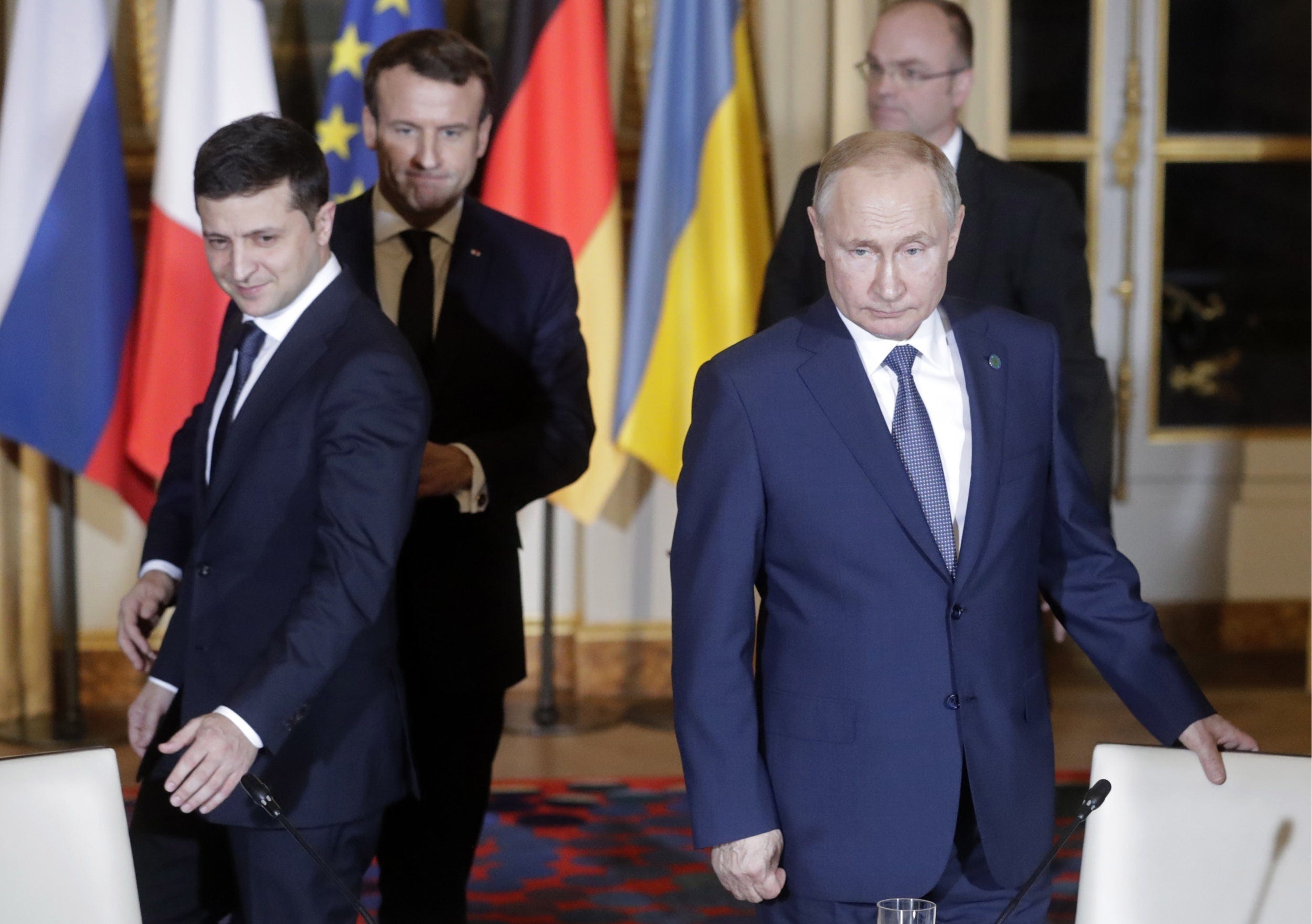
Attending a politically-charged meeting such as this would see Putin meet with a notable foreign adversary in a situation where both would be seen as equals, inadvertently granting legitimacy to the last head of state Putin wants to grant legitimacy to. If the Russian president were to find himself on the receiving end of scathing vitriol from Zelenskyy, it could also crush Putin’s strongman image and cause both international observers and constituents in his home country to depict him as weak instead.
As Ukrainian politician and lawyer Oleksandr Merezhko said with respects to the proposed meeting:
“Putin does not see himself as Zelensky’s equal, and has repeatedly mocked him and called him “illegitimate,” so to appear on the same level on the global stage would, in Russian eyes, make him look “really weak””
It’s fair to say that Russia finds itself in a political, militaristic, and economic quagmire. Suffocated under imminent threats of crippling sanctions, an unsuccessful, deadly war effort, and further geopolitical isolation, the Kremlin is in desperate need of breathing room. But how bleak is the situation, and what options does Russia have to traverse this predicament?
Status of the War
Russian media, allies, and politicians alike were optimistic about their chances of prevailing in a full-scale invasion of Ukraine. Putin refused to label the situation a ‘war’ or ‘invasion’, instead preferring the term ‘special military operation’ to minimize the scale of the conflict and portray Russia’s presence in the country as temporary and limited compared to the protracted commitment of war.
Kremlin ally and president of Belarus Aleksandr Lukashenko proclaimed in Belarusian media that Russia would take Ukraine in 3-4 days, while Putin himself reportedly claimed in 2014 that he could take Kyiv in two weeks, a claim that he continued to harbor in 2022. Russian invasion plans obtained by the New York Times appear to corroborate the timelines Lukashenko and Putin proposed.
Russian logic was rooted in two core assumptions. The first was that the West had become weakened from internal political divisions, foreign policy disasters such as the Afghanistan withdrawal, and the rise of countries like China that sought to challenge the American-led international order.
The second was the assumption that Russia had a pronounced military advantage over Ukraine. From manpower to tanks to aircraft, common wisdom within and outside of Russia was that the nation ranked among the top two most powerful militaries on Earth, and any confrontation with Ukraine would result in a sweeping victory akin to that of Georgia in 2008 or Crimea in 2014.
As we now know, a sweeping Russian victory did not materialize.
Russia experienced significant setbacks from the start of the war. The Battle of Kyiv lasted from February to April of 2022. Intended as a surprise attack on the Ukrainian capital, the battle led to tremendous losses of life for both Ukraine and Russia. In the end, Russia failed to topple the Ukrainian government and the strategic and tactical failure of Kyiv forced Putin to halt operations in the north and northeast. What was intended as a multi-pronged, quick-fire invasion shifted to a regional campaign centered on Russian military control of eastern Ukraine.
A harbinger of what was to come for Russia, further losses would ensue in the aftermath of Kyiv. In May, Ukrainian armed forces would destroy a Russian battalion in the strategically vital village of Bilohorivka in the Donbas region, damaging over 89 pieces of Russian military equipment in the process. This would be followed up by a successful Ukrainian counteroffensive in the province of Kharkiv that September.
Ukraine would deal Russia an even harder blow in November when they liberated the Russian-occupied city of Kherson, a crucial port on the Black Sea that was – at the time – the only Ukrainian provincial capital under Russian control. Seizing control of Kherson was of additional militaristic importance as it gave Ukraine a natural buffer in the form of the Dnipro river.
In hindsight, it wasn’t hard to foretell Russian losses in Ukraine. Russia’s military logistics have been overly reliant on railway infrastructure which has made them a prime target for sabotage and disruption. Supply lines have also suffered from poor planning and limited support. Russian battalion tactical groups (BTGs) field 700-900 troops on average, of which only around 150 are designated logistical support responsibilities. By comparison, the U.S. Army deploys about 10 support soldiers for every combat soldier.
The Russo-Ukrainian war has also exposed Russia’s over-reliance on outdated Soviet-era weaponry. While Ukraine received Western-manufactured ATACMS and Patriot missiles, Russia installed outdated engines on their cruise missiles. While Ukraine fielded M1 Abrams tanks, Russia settled for T-54/55 tanks manufactured between the 1940s and 1970s. What’s worse is that Ukraine has captured countless Russian weapons, and it has become apparent that Russia doesn’t have the industrial capabilities to replenish these losses and continue supporting a large-scale war effort.
The current zones of control in Ukraine, as of early May, look like this:
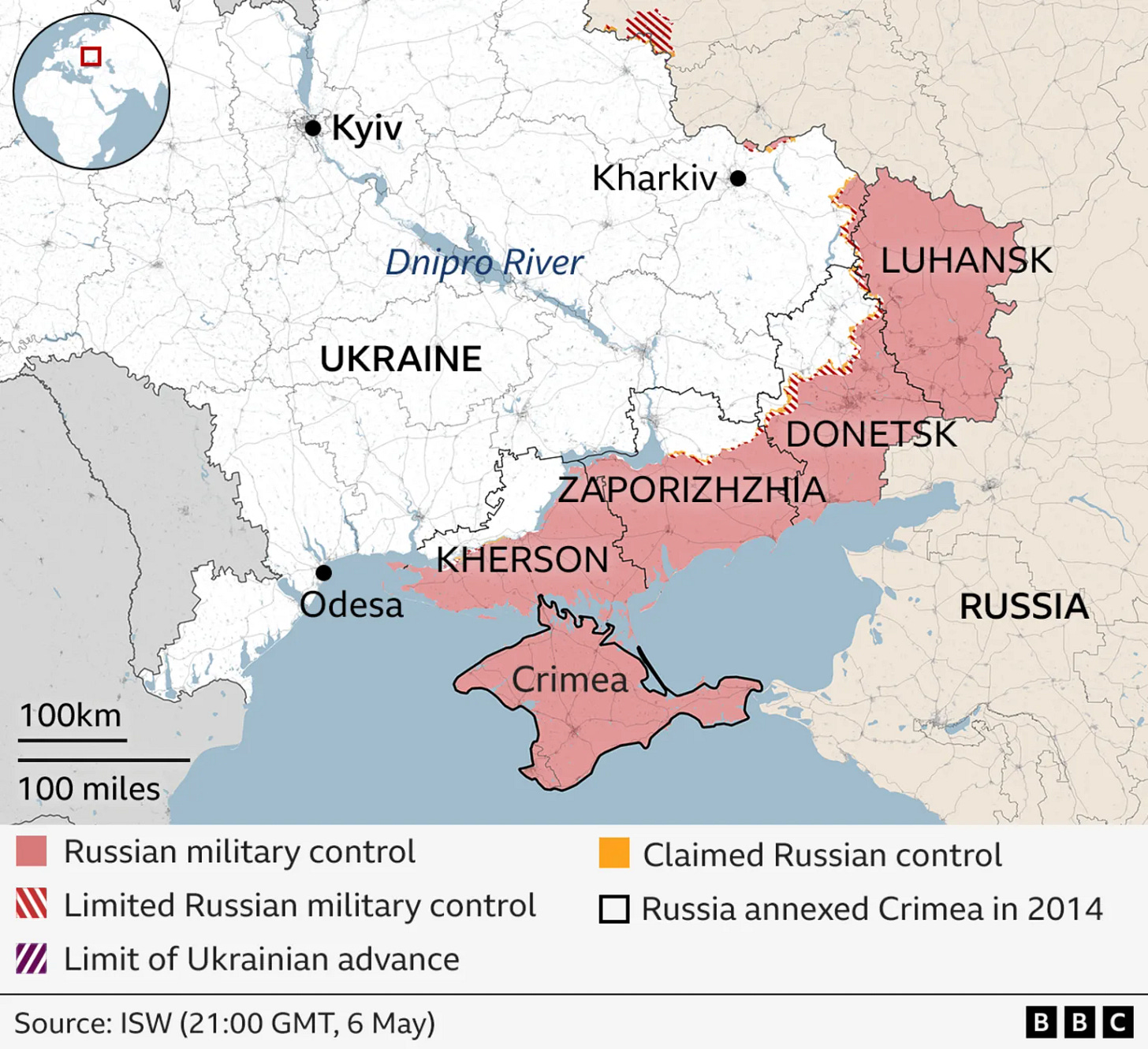
A far cry from its lofty initial expectations, the vast majority of Russia’s occupied territory in Ukraine is concentrated in parts of the Kherson, Zaporizhzhia, Donetsk, and Luhansk oblasts. The line of control has barely changed in the past year, indicating that the conflict has largely entered a stalemate.
In spite of this, Russia has lost men and continues to lose men at an alarming rate. 2024 was the deadliest year for Russian soldiers in Ukraine, with 45,287 identified members of the Russian Armed Forces losing their lives last year alone. The true death toll is likely much higher. Military recruitment is plunging, forcing Putin to recruit foreigners and criminals.
A miscalculation at best and a generational embarrassment at worse, the invasion of Ukraine has not panned out the way Moscow intended it to. Ukraine’s sovereignty remains intact, NATO and EU expansion has accelerated in response to the war, and the results on the battlefield have not justified the underlying human toll.
Russia’s Economic Situation
It served as a shock to few when Western countries imposed crushing sanctions on Russia in 2022. The United States and the European Union, among other countries such as Japan, South Korea, and Australia, have frozen $350 billion worth of Russian foreign reserves and 70% of assets in Russian banks. In total, over 21,692 sanctions have been imposed on Russia since the invasion, targeting oligarchs, politicians, companies, and institutions.
The sanctions had instant ramifications on the Russian economy. GDP shrunk considerably in 2022 and 2023, while annual inflation nearly doubled from 9.2% in February 2022 to 16.7% in March 2022.
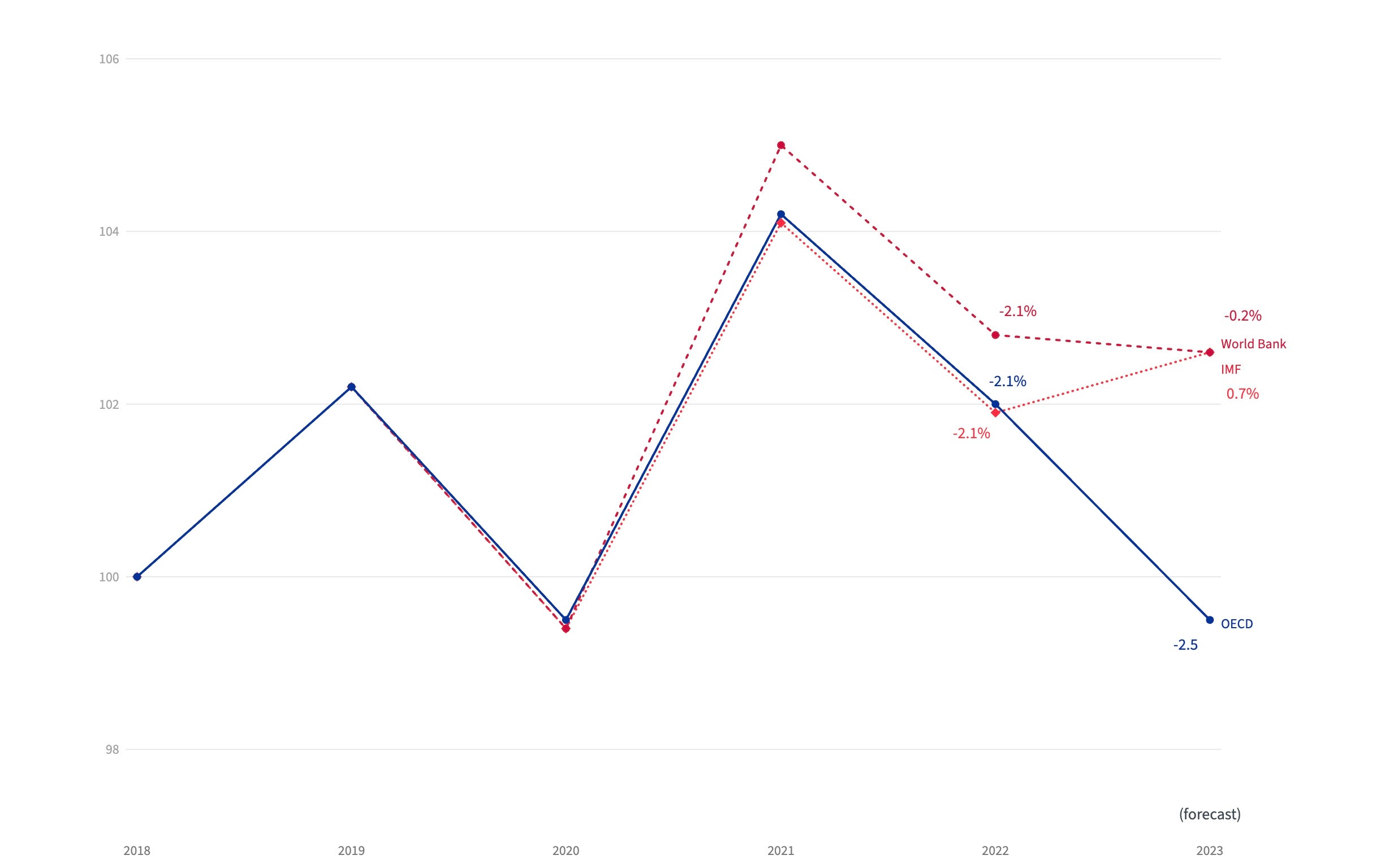
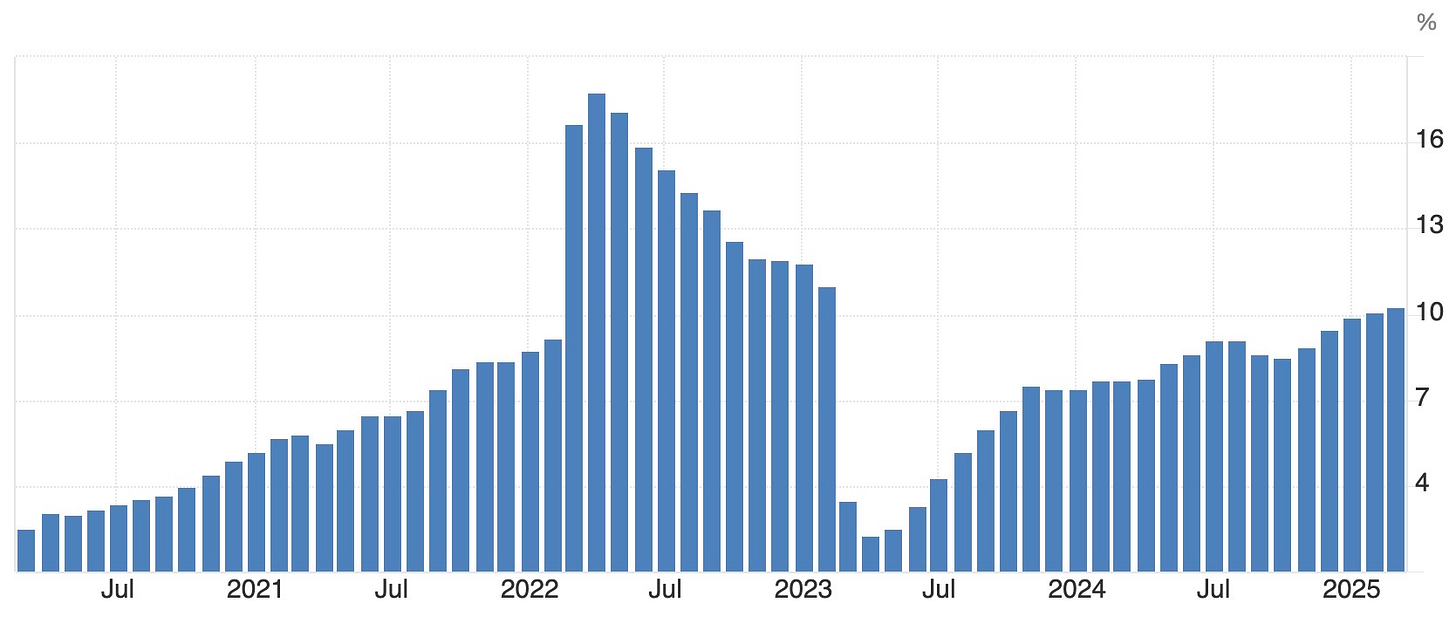
Whether or not the sanctions have worked is subject to interpretation. If one interprets a ‘sanction success’ as cutting Russia off from the Western economies, sanctions have been mostly effective. Monthly exports to Russia from the West collapsed by $5.9 billion in 2023 compared to 2022 and the EU’s imports of Russian gas have dropped by 90% since the invasion of Ukraine.
If the efficacy of sanctions is to be measured instead by their ability to end Russian aggression in Ukraine, they have failed. The war has become prolonged with no obvious end in sight and Russia has been able to fund its war effort by forging strategic trade partnerships with countries such as Kazakhstan, China, and India.
Make no mistake, the consensus remains overwhelming: Russia’s economy is struggling. Mineral resources account for 68% of Russian export volume and oil and gas accounts for 54% of export revenue. While neighboring countries embrace skilled industries and advanced sectors, Russia remains resource-dependent, subjecting itself to the whims and speculative volatility of global commodity prices. Falling oil prices, for example, have the possibility to halt war spending and worsen economic indicators nearly instantaneously, making Russia an unreliable market for foreign direct investment (FDI). The whole war thing doesn’t help, either.
Russia’s tech industry is in a full-blown crisis. Over 100,000 tech specialists and 1,000 foreign firms exited the country after the invasion of Ukraine. IT only made up 3.2% of Russian GDP in 2021, but was directly responsible for more than a third of the country’s GDP growth ($47.8 billion). Russian support for IT and STEM is limited as gross domestic spending on research and development (R&D) has averaged around 1% of GDP, and federal tech investments have been notoriously inefficient. For example, the Skolkovo Innovation Center was a 2010 Russian government-sponsored initiative to create a ‘Russian Silicon Valley’. Instead, it became embroiled in scandals, corruption, and inefficient allocation of resources, a microcosm for the wider Russian tech industry.
Russia currently operates a tight skilled labor market where there are more job vacancies than skilled workers, fueled by a shortage of technical and specialist graduates. By the end of 2024, Russian companies faced a shortage of 2.6 million workers as a result of poor economic policy, low birth rates, and a shift to a wartime economy. Manufacturing, trade, and transport have been the most heavily impacted sectors and have forced Russia to rely on nontraditional labor sources such as Southeast Asian migrants.
Several banks have stopped trading with Russia as a result of Russian financial institutions being excluded from the SWIFT system of international payment messaging. Personal disposable income in Russia is 20-25% lower as a result of the war, and inflation is estimated to be over 20%.
In response, the Russian Central Bank has pursued a contractionary monetary policy by raising interest rates to over 20%. Russia has also relied on its National Wealth Fund – a fund of returns generated from government investments – to fund critical spending programs. In doing so, the fund’s liquid assets have been depleted from $117 billion to $31 billion.
Diplomatic Strategies
With a precarious economic and military situation, Russia has been dealt a challenging negotiating context. Navigating this could be crucial in determining the future of Russia in today’s ever-changing geopolitical climate.
From a realist international relations perspective, Putin cannot accept an unconditional peace. Russia instigated the current conflict and promised a swift, resounding victory in Ukraine that would have resulted in complete control of the country. Anything less than this would be a political catastrophe for Putin that would demonstrate frailty at the international level and jeopardize his irredentist vision of a greater Russian state (planned invasions/annexations of Belarus, Kazakhstan, and the Baltic States would be completely discarded if Putin comes away from Ukraine empty-handed).
This political reality explains why Russia has emerged as the foremost roadblock to peace in Europe, and why negotiations with Russia have divulged into a concessions bidding war. Putin is aware of the reality on the ground: Russia is losing the war. In a state such as Russia where ethnic, sectarian, and societal divisions permeate throughout society, the Kremlin has come to terms with the fact that a decisive loss in Ukraine could be the straw that breaks the camel’s back.
Putin has a mandate to deliver results to the Russian people, and if that doesn’t come in the form of territorial gain, it will have to come in the form of major concessions from Ukraine and the West. As Assad in Syria has proven recently, no dictator is ever immune from overthrow, no matter what illusions of safety they may curate for themselves.
In future negotiations, Russia has to walk a fine line between pursuing its own interests in Ukraine and abiding by the terms of the United States to keep its diplomatic partnership afloat. President Trump and his administration have expressed a strong willingness to offer concessions to Russia ranging from the removal of sanctions to the denial of Ukrainian NATO membership.
Russia must make the most of having the world’s preeminent arbitrator on its side. To do so, it will have to make concessions of its own. Their diplomatic strategy has been uncompromising so far, refusing to express support for ceasefire or peacekeeping proposals. Putin has his work cut out for him in Ukraine negotiations, but he risks losing the only path to a Russian victory – the Trump administration – if he becomes overzealous in his pursuit of Western favors to Russia.
There are already signs that show the tide is turning against Russia. J.D. Vance said earlier in May of this year that he believed Russia was ‘asking for too much’ to end the war in Ukraine. Trump has also made it clear to the Kremlin that he is not afraid to impose more sanctions on Russia if peace is not achieved.
The easiest way for Russia to escape its current predicament is to play a strategic war of diplomatic attrition. By prolonging negotiations, Russia can afford to obtain more favors from Western nations and potentially delay the imposition of sanctions. However, their approach must change from assertive and confrontational to cordial and diplomatic. The key is to show a demonstrated interest in achieving peace, something that Russia has failed to do up to this point.
The concern is whether Ukraine and the West will embrace this model of Russian diplomacy. As mentioned in the beginning, European nations’ ultimatums against Russia – from the Istanbul meeting to the recent ceasefire demands – have put Russia in a chokehold that soft diplomacy alone won’t ameliorate. The next step is to play into the United States’ interests by emphasizing the importance of striking a deal, after which they can rely on America to do the heavy lifting. The Trump administration’s ability to strike a ceasefire and minerals deal with Ukraine after initial opposition shows that Kyiv’s diplomatic aims aren’t immutable, a positive for Russia that they should take full advantage of.
Here is the real challenge for Russia: they have no leverage in negotiations. In diplomacy, deterrents are critical if you don’t want your country to be on the receiving end of an unfavorable deal. For a long time, Russia’s military prowess, oil and gas exports, and political alliances acted as deterrents for Western countries looking to get tough on the Eurasian nation. However, the recent Russo-Ukrainian War has exposed the weaknesses of Russia’s military capabilities, reduced Western countries’ dependency on Russian oil and gas exports, and virtually isolated the nation politically.
To expand on the last point, who are Russia’s main allies? China and India are strategic partners, but neither will come to Russia’s defense in the war given their ties with Western nations and contrasting political priorities. Both nations are preoccupied with their own conflicts with Taiwan and Pakistan respectively, and don’t want to throw their explicit support behind Russia at the expense of potential sanctions and isolation (particularly critical given their ambitions of superpower status in a hypothetical multipolar world).
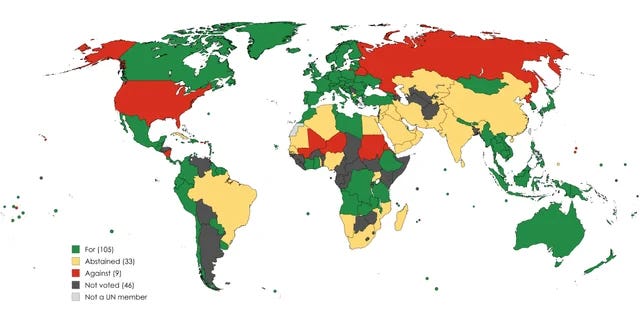
This leaves Belarus, Kazakhstan, and North Korea as strong allies, while the likes of Hungary, Serbia, Iran, Cuba, Venezuela, and a host of central African countries defend Russia’s actions on occasion – usually more of a message against Western influence than a show of support for Moscow. Not really a frightening coalition, let alone a deterrent. Stripped of foreign, economic, and political leverage, the odds of a wider Russian diplomatic victory have become infinitesimally small.
One of the great regional and global powers, the Russian Federation is currently enduring one of the greatest trials in its modern history. All roads seemingly lead to seismic failure or at the very least a national embarrassment the likes of which haven’t been seen since the collapse of the Soviet Union. Whether or not their situation is salvageable is yet to be seen, but it would be far from unreasonable to begin drafting Russia’s obituary. The Istanbul summit – if it is to occur – and its aftermath will serve as a litmus test of the Kremlin’s status as one of geopolitics’ premier power players and whether or not it will be able to sustain it.
~ Original article found on Substack ~
Bibliography
CBS News. “Vladimir Putin Sits down with Ukraine President Zelensky for the First Time Today.” CBS News, 9 Dec. 2019, https://www.cbsnews.com/news/vladimir-putin-sits-down-with-ukraine-president-zelensky-for-the-first-time-today-2019-12-09/.
Farchy, Jack, and Henry Meyer. “Inside the Power Struggle in Putin’s Russia as Prigozhin Takes Belarus Deal.” Bloomberg, 25 June 2023, https://www.bloomberg.com/news/features/2023-06-25/inside-the-power-struggle-in-putin-s-russia-as-prigozhin-takes-belarus-deal?embedded-checkout=true.
“Russia-Ukraine War.” AP News, https://apnews.com/article/russia-ukraine-war-fbd6aa9ddb147fa1b789c30dcf44dab3.
Michta, Andrew A. “Germany Pushes for Russia-Ukraine Ceasefire despite Sanctions.” Newsweek, https://www.newsweek.com/germany-russia-ukraine-ceasefire-sanctions-2070993.
“Ukraine’s Zelensky Says Not Ready for Talks with Russia Unless Troops Withdraw.” France 24, 5 Nov. 2023, https://www.france24.com/en/europe/20231105-ukraine-s-zelensky-says-not-ready-for-talks-with-russia-unless-troops-withdraw.
Picheta, Rob. “Putin Calls for Victory Day Ceasefire in Ukraine.” CNN, 7 May 2025, https://www.cnn.com/2025/05/07/europe/putin-victory-day-ceasefire-ukraine-latam-intl.
Welna, David. “Zelenskyy and Putin Explore Ceasefire with Turkey’s Mediation.” NPR, 12 May 2025, https://www.npr.org/2025/05/12/nx-s1-5395538/zelenskyy-putin-ukraine-russia-ceasefire-turkey.
Ward, Myah. “Trump Plans Travel for Russia-Ukraine Peace Talks.” Politico, 12 May 2025, https://www.politico.com/news/2025/05/12/trump-travel-russia-ukraine-peace-talks-00341968.
Mastrangelo, Dominick. “Trump Weighs Role in Russia-Ukraine Peace.” The Hill, https://thehill.com/policy/international/5265907-trump-russia-ukraine-peace/.
“Putin Says Ready for Peace Talks but Not with ‘Illegitimate’ Zelenskiy.” Radio Free Europe/Radio Liberty, https://www.rferl.org/a/putin-ready-peace-talks-not-with-illegitimate-zelenskiy-/33294979.html.
“Putin and Zelensky Hold Press Conference after Talks.” The Independent, https://www.independent.co.uk/news/world/europe/putin-zelensky-press-conference-russia-ukraine-prisoners-a9239656.html.
“Security Council Fails to Adopt Draft Resolution on Ukraine.” United Nations, 25 Feb. 2022, https://press.un.org/en/2022/sc14803.doc.htm.
NEXTA. “Video of Ukraine-Russia War Developments.” X, 28 Feb. 2022, https://x.com/nexta_tv/status/1498185064617762816.
“Putin Boasts He Could Take Kiev in Two Weeks.” Time, https://time.com/3259699/putin-boast-kiev-2-weeks/.
Troianovski, Anton. “How Putin’s War in Ukraine Failed.” The New York Times, 16 Dec. 2022, https://www.nytimes.com/interactive/2022/12/16/world/europe/russia-putin-war-failures-ukraine.html.
Taylor, Adam. “Putin, Patriarch, and the Decline of Russian Cultural Power.” The Washington Post, 15 Apr. 2022, https://www.washingtonpost.com/politics/2022/04/15/putin-patriarch-ukraine-culture-power-decline/.
“Russo-Georgian War.” Wikipedia, https://en.wikipedia.org/wiki/Russo-Georgian_War.
“Russian Annexation of Crimea.” Wikipedia, https://en.wikipedia.org/wiki/Russian_annexation_of_Crimea.
“Analysis of Russia’s Loss in Fording the Siverskyi Donets River.” NV English, https://english.nv.ua/nation/analysis-of-russia-s-loss-in-fording-the-siverskyi-donets-river-in-donbas-ukraine-ukraine-news-50244106.html.
“Russian Forces Appear to Be in Disarray as Ukraine Expands Control.” The Week, https://theweek.com/russo-ukrainian-war/1016604/russian-forces-appear-to-be-in-disarray-as-ukraine-expands-consolidates.
“Russia-Ukraine War: Latest Updates.” BBC News, https://www.bbc.com/news/world-63511626.
“Ukrainian Railway Sabotage Increasingly Unsettles Kremlin.” Jamestown Foundation, https://jamestown.org/program/ukrainian-railway-sabotage-increasingly-unsettles-kremlin/.
“US Approves Transfer of ATACMS and Patriot Missiles.” United24 Media, https://united24media.com/latest-news/us-approves-transfer-of-atacms-and-patriot-missiles-from-germany-to-ukraine-8277.
“Biden Announces Abrams Tanks to Ukraine.” U.S. Department of Defense, https://www.defense.gov/News/News-Stories/Article/article/3277910/biden-announces-abrams-tanks-to-be-delivered-to-ukraine/.
“Ukraine: Russia Weapons.” Deutsche Welle, https://www.dw.com/en/ukraine-russia-weapons/a-66497796.
“Russian Manufacturing PMI Falls to Lowest Level.” The Moscow Times, 1 Apr. 2025, https://www.themoscowtimes.com/2025/04/01/russian-manufacturing-pmi-falls-to-lowest-level-since-april-2022-a88558.
“Russia-Ukraine Updates.” BBC News, https://www.bbc.com/news/articles/c5yg4z6v600o.
“Russia Turns to Foreigners and Criminals as Recruitment Plunges.” The Moscow Times, 3 Feb. 2025, https://www.themoscowtimes.com/2025/02/03/russia-forced-to-turn-to-foreigners-and-criminals-as-moscow-military-recruitment-plunges-fivefold-a87835.
“Ukraine Crisis: Latest.” BBC News, https://www.bbc.com/news/world-europe-60125659.
“Russia Sanctions Dashboard.” Castellum.AI, https://www.castellum.ai/russia-sanctions-dashboard.
“Impact of Sanctions on Russian Economy.” European Council, https://www.consilium.europa.eu/en/infographics/impact-sanctions-russian-economy/#0.
“Russia Inflation (CPI).” Trading Economics, https://tradingeconomics.com/russia/inflation-cpi
Bruegel. “Emerging Countries Have Replaced Most of Russia’s Lost Trade with Advanced Economies.” Bruegel, https://www.bruegel.org/analysis/emerging-countries-have-replaced-most-russias-lost-trade-advanced-economies#:~:text=The%20second%20main%20import%20item,drop%2C%20at%20$12.0%20billion.&text=Russia’s%20full%2Dscale%20invasion%20of%20Ukraine%20in%20February%202022%20has,by%20medicines%20%E2%80%93%20and%20agricultural%20products.
“Sanctions: Russian Economy Could No Longer Survive without China, India and Turkey.” Deutsche Welle, https://www.dw.com/en/sanctions-russian-economy-could-no-longer-survive-without-china-india-and-turkey/a-71606396#:~:text=From%20west%20to%20east,2021%20to%2015%25%20in%202024.&text=%22There%20was%20a%20major%20diversion,seen%20modest%20increases%20since%202021.
“China and Russia Strengthen Ties amid Ukraine War.” CNN, 15 May 2024, https://www.cnn.com/2024/05/15/business/china-russia-ties-ukraine-war-intl-hnk-dg.
“Russia Built Secret Trade Route with India to Acquire Critical Goods for Its War.” Deccan Herald, https://www.deccanherald.com/india/russia-built-secret-trade-route-with-india-to-acquire-critical-goods-for-its-war-in-ukraine-report-3176820.
Alexeev, Michael, and Galina Kurlyandskaya. “Fiscal Federalism and Incentives in Russia.” Defence and Peace Economics, vol. 24, no. 6, 2013, https://www.sciencedirect.com/science/article/abs/pii/S156601412300064X#:~:text=Introduction,Alexeev%20and%20Kurlyandskaya%2C%202013).
Kramer, Andrew E. “Russia Hit by Plunging Oil Prices.” The New York Times, 10 Apr. 2025, https://www.nytimes.com/2025/04/10/world/europe/russia-oil-prices.html#:~:text=The%20plunge%20in%20oil%20prices%20has%20struck,less%20diversified%20than%20those%20of%20its%20peers.&text=Even%20before%20oil%20prices%20nose%2Ddived%2C%20Russia’s%20budget,the%20first%20two%20months%20of%20this%20year.
“Russian FDI Falls to 15-Year Low.” The Moscow Times, 10 Feb. 2025, https://www.themoscowtimes.com/2025/02/10/russian-fdi-falls-to-15-year-low-as-russia-faces-wrong-kind-of-growth-a87918.
“Russia’s Tech Industry Faces Isolation.” MIT Technology Review, 4 Apr. 2023, https://www.technologyreview.com/2023/04/04/1070352/ukraine-war-russia-tech-industry-yandex-skolkovo/.
“Russia’s Digital Tech Isolationism.” Atlantic Council, https://www.atlanticcouncil.org/in-depth-research-reports/issue-brief/russias-digital-tech-isolationism/#:~:text=Since%20the%20Putin%20regime%20launched,Russian%20government%20and%20technology%20sector.
“Russia’s Fracturing Economy: Strategic Snapshot.” Jamestown Foundation, https://jamestown.org/program/strategic-snapshot-russias-fracturing-economy/.
“Russia Faces Severe Labor Shortage.” Pravda, 13 May 2025, https://www.pravda.com.ua/eng/news/2025/05/13/7512020/.
“Russia’s Severe Labor Crunch.” Geopolitical Futures, https://geopoliticalfutures.com/russias-severe-labor-crunch/#:~:text=The%20Kremlin%20needs%20higher%20production,send%2010%2C000%20workers%20to%20Russia.
“Is 2025 the Year Russia’s Economy Freezes under Sanctions?” Atlantic Council, https://www.atlanticcouncil.org/blogs/new-atlanticist/is-2025-the-year-that-russias-economy-finally-freezes-up-under-sanctions/.
“Sanctions Effectiveness: What Lessons Three Years into the War on Ukraine?” Economics Observatory, https://www.economicsobservatory.com/sanctions-effectiveness-what-lessons-three-years-into-the-war-on-ukraine.
“Russia’s Economy under Pressure.” Re-Russia, https://re-russia.net/en/analytics/0202/.
“Bashar Al-Assad of Syria Has Been Ousted from Power.” Carnegie Endowment for International Peace, Dec. 2024, https://carnegieendowment.org/middle-east/diwan/2024/12/bashar-al-assad-of-syria-has-been-ousted-from-power?lang=en.
“Full Text of US Peace Proposal at Odds with Ukrainian and EU Positions.” Kyiv Independent, https://kyivindependent.com/full-text-of-us-peace-proposal-at-odds-with-ukrainian-eu-positions-reuters-reports/.
“Ukraine NATO Membership Off the Table.” Yahoo News, https://www.yahoo.com/news/nato-membership-ukraine-off-table-022109426.html?guccounter=1&guce_referrer=aHR0cHM6Ly93d3cuZ29vZ2xlLmNvbS8&guce_referrer_sig=AQAAANwZVZdqNUZTzplI10GizdraRzXHNfwL37ANDdUujvxXzW5IEEI4QF6YZJyX6oAo-X9p6WkKrj5ThHG6_R5Q21MiUVJVyvjOqBMkYslSzGviVO6ApQkSndMMxK4I0Cme37PM4YZijDF2DFJRnlwFGuySqu1qK8L9TNJcSOljzwUS.
Ward, Myah. “Vance Meets in Munich to Discuss Russia-Ukraine Conflict.” Politico, 7 May 2025, https://www.politico.com/news/2025/05/07/vance-munich-meeting-russia-ukraine-00332623.
Troianovski, Anton. “Ukraine, Russia, and Trump in Peace Talks.” The New York Times, 9 May 2025, https://www.nytimes.com/2025/05/09/world/europe/ukraine-russia-zelensky-trump-peace-talks.html.
“United States and Russia Vote against UN Measure on War in Ukraine.” United24 Media, https://united24media.com/latest-news/united-states-and-russia-vote-against-un-measure-on-war-in-ukraine-7685.
~ Original article found on Substack ~
 Publius News
Leave a comment